Friday, December 12, 2014

Summative Reflection Project

VTS Student Mosaic:


Closer view of a section in the VTS Student Mosaic:

(created using AndreaMosaic)

Artist’s Statement:

When I began this course, I had one experience as a participant in the discussion process, which resonated with me to the point of wanting to learn more.  The three prescribed questions seemed effective, the gesturing and paraphrasing was helpful in focusing my ideas and linking them to others’, and the facilitator’s neutrality encouraged me to contribute.  All of these aspects of VTS were interesting, but what intrigued me most about VTS was the level of engagement I felt as a participant.  I enjoyed looking at the image, I wanted to share my ideas, and new ideas came to me as I listened to others share.  I thought about the image long after the discussion, and I still recall details about the image and the discussion, which took place over six months ago.  When I am interested - I seek to learn more, and when I learn more- I want to share with others. 

Although I was enthusiastic about sharing the VTS experience with my students, I was admittedly skeptical.  So many times throughout my career I have learned an amazing teaching strategy that immediately fell flat when I brought it to my classroom.  What if my students were bored?  What if they questioned the use of images in Language Arts class?  What if they didn’t take it seriously?  And worst of all- what if it proved to be a waste of valuable instructional time?  Fortunately, all of these “what ifs” were dismissed during the first session with my students.

My students responded to their first VTS experience in much the same way as I did.  They were engaged, they shared ideas, listened to others, and then shared more ideas.  At first their observations were fairly simple, and I found myself asking, “What do you see that makes you say…” in response to fairly obvious interpretations.  By the second discussion, they were forming narratives collectively and occasionally, respectfully disagreeing with each other.  All students were engaged in viewing, but not all students participated in the discussions at first.  I noticed the inferences gradually became more detailed and had more depth.   I noticed I asked, “What do you see that makes you say…” fewer times because anticipated the question and began providing evidence without being prompted. This challenged me to look for areas to uncover and provide opportunities for students to dig deeper.   I was thrilled to see my students grow, and wonder, and collaborate, and be genuinely engaged in thinking about an image.

My greatest challenge with VTS was figuring out how to navigate the inclusion of a struggling student who withdraws from classroom discussions.  I hoped VTS would help cultivate a positive classroom environment through which he would be encouraged to participate.   Although he never chose to share his ideas during discussions, he gradually began participating in every VTS by joining the group.  He has made tremendous progress both academically and socially this semester.  The classroom is no longer intimidating, and he participates in group activities for the first time.  The only strategy I used with him was implementing VTS in Advisory.  My goal was for him to participate in the discussions, but I feel like he has accomplished even more.  VTS seems to have provided an opening for him to feel included and valued, and to build a positive relationship with his peers and with me. 

In reflecting on this process and experience, I wanted to create a visual piece to symbolize this VTS experience I have shared with my students.  My idea was to create something from the visual perspective of the image- as the image views the students.  Feeling limited by my knowledge of materials and process, I moved to focusing on the layers and metaphors I could use to communicate my ideas.  I am most comfortable creating collages, and since much of my VTS experience required the use of technology through online learning and the VTS website, I thought a digital collage could best represent these aspects.  I chose to use the image sets recommended for middle school grades since many of these images are ones my students and I viewed together.  Although my original intention was to create an abstract piece, I had a breakthrough idea during one of our VTS discussions.  As students sat with their hands raised, I realized how I could represent my experience as facilitator and incorporate my students into the piece.  This mosaic was created layering the images students view to create the larger image of a student viewing. I experimented with AndreaMosaic, which I had not used before, until I finally achieved the feeling I wanted to convey. For me, this image is a metaphor about the shared VTS experience with the layered images collaborating with the image of a student.  This piece is meant to represent the culmination of viewing art, creating art, sharing ideas, learning, and finding more- which encapsulates my VTS experience.


Wednesday, December 10, 2014

Pre/Post Scoring Rubric Data

 Pre/Post VTS Scoring Rubrics:


Word Count:  I hoped the word count calculations would prove a positive increase.  I noticed an increase in participation during our VTS discussions, both in the number of students participating and the length of the discussions.  My prediction was that with this experience in viewing and discussing images, students would be better able to discuss an image independently through their writing.  

My t-value of 2.8864 is much higher than my critical value of 1.73.  These results are very statistically significant!  I reject the Null Hypothesis because there is a very significant difference between my Pre and Post VTS scores regarding word count.  The Post test scores were much higher than the Pre-test scores.  Yea!


Interpretations/Inferences w/ Evidence:  I chose this category because it is a writing skill I continuously try to help my students develop.  Even though I remind them to provide evidence on every written response, many still struggle to do so.  When I gave the Pre-test, I followed the prescribed directions, therefore I did not give them any "reminders".  Of the 19 Pre-tests I scored, only one student provided evidence for an interpretation.  And he only did it once.  :(

But after VTS...


My t-value of 5.4766 is much higher than my critical value of 1.740.  These results are considered EXTREMELY statistically significant!  Again, I reject the Null Hypothesis because there is a very significant difference between my Pre and Post VTS scores regarding word count.  The Post test scores were much higher than the Pre-test scores.

My mind is blown!  As I scored the Post tests, I noticed almost every student provided evidence with every description!  They've done this in VTS discussions, but I was concerned that the verbal discussion might not translate to their writing or that the second question would be ignored when responding independently.  Nope!  I can't even put into words how amazing this is! YEA!

Friday, December 5, 2014

VTS Week 14 Blog Assignment

Portrait of Possibility Revisited

During week #5 I identified Sam, a struggling, withdrawn seventh grade boy, as a student who would benefit from VTS because the discussions build classroom community in a non-threatening environment.    There is no wrong answer in VTS discussions, so I thought Sam would feel more comfortable and less withdrawn.  As I began studying the images, I thought Sam would find them engaging, but I also thought they would challenge him to “find more”.  

My initial plan was to encourage Sam earlier in the day by acknowledging his participation after our previous discussion.  This plan backfired.  Sam responded immediately by saying, “I don’t want to. I’m not going to do that.”  

Despite his initial withdrawal, Sam has shown progress- and not only during VTS discussions.  He began the school year spending much of his day in the office, but he hasn't been there in weeks.  He was failing most of his core classes, but his grades have now improved in all areas.  I used to have to sit next to him during Advisory in order for him to complete his homework, and he was spending one class period with the guidance counselor so she could sit with him.  Sam is now working independently, and taking responsibility on his own. 

Last week we had a parent meeting, and his mother told me he loves my class.  Then, after school, my Principal came to talk to me.  He told me Sam’s mother had stopped by the office after our meeting and talked to him about Sam’s progress.  He said she attributed this to my influence!  She saw the change in his behavior at home too and didn't know how I “cracked the code” but she was glad I did.  I honestly believe the VTS discussions are responsible for the change.  Even though he doesn't verbalize his thinking, he is still affected by the cooperative community and positive learning environment.  Prior to this year, the classroom was an intimidating place for Sam, but this year his experience is different.  I believe VTS has opened the door for Sam.  VTS “cracked the code.”

Friday, November 21, 2014

VTS: Week 13 Blog Assignment

VTS as Differentiated Instruction:

Without differentiated instruction, many of my Advisory students would fall behind, some would lack motivation because they are uninspired, and the others would not be challenged to reach their potential.  This is a varied group- academically, socially, and emotionally.  In Johnson's article, "Differentiated Instruction Allows Students to Succeed" he discusses the importance of "meet(ing) students where they are "and "allow(ing) for do-overs".  VTS does this for my Advisory students because it provides opportunities to build vocabulary, scaffold learning, practice with multiple images (mediums) and revise thinking without the pressure of one right answer. Johnson's "Active Learning Is Key to Differentiated Instruction" emphasizes providing activities that are intrinsically differentiated, which involves creating cooperative groups and encouraging student inquiry.  VTS discussions promote cooperative learning within the group by linking student responses, and it encourages student inquiry by asking students to continually find more.  My Advisory group is great at linking their responses, and I've noticed that sort of linking has trickled into other class discussions.  With each discussion we've completed, students' observations become increasingly more detailed, and every student participates, which Tomlinson discussed in the process component of differentiation.    I feel more of a sense of community with this Advisory group than I have with other in the past, and I attribute this to our VTS experiences.  VTS does create a positive learning environment- another necessary element discussed by Tomlinson.  Through VTS discussions we are able to share ideas collectively in what would normally be a study hall- void of collaboration.

Thursday, November 13, 2014

VTS: Week 12 Blog Assignment/Video

Video C of Lesson #5 (Teacher's Choice):


Norman Rockwell, Girl with a Black Eye, 1953.


Assessing, Reflecting, Planning:

I do think the image I chose was appropriate for my students because the subject matter is familiar to them.  One student noticed the filing cabinet and commented that the picture was older because we don't use filing cabinets much anymore.  There was a consensus that the picture is of a student waiting outside the Principal's office.  Because the setting is familiar, students were easily able to create a narrative.  

The image challenged this group of students to make sense of or find a reason why this person is sitting outside the Principal's office.  The very first observation was that she had been in a fight and won.  The next student recognized the theme of bullying, but thought this girl was being bullied and finally beat the bully.  The discussion moved to the gender of the girl- some thought it might actually be a boy, and the date of the subject matter.  One student was reminded of Pippy Longstockings.  I felt like they were on the cusp of considering the artist's intent with the choice to make this fighter a girl, but they didn't quite get there.  Every time I thought they were warm, they would then focus on specific details, like clothing, to question the gender of the subject.  My students live in a rural area, and we have very few behavior issues... I think they were attempting to create a narrative that made sense to them because the idea of this cute little girl beating someone up wasn't a reasonable explanation.  I was hoping to challenge them with ideas about stereotypes, but it didn't work out as I hoped.  

This group of students does a great job listening to each other and linking their ideas.  Everyone was engaged and participating equally, which was a goal of mine since past discussions have been male dominated.  I did have them all gather closely around, which helped, but I think the image captivated the students as well.  They were scaffolding- a few boys provided evidence of another culture based on their background knowledge, and some students made assumptions about the time period by noticing clothing, hairstyles, and objects in the picture.  I wanted to help them delve deeper into the ideas about bullying and gender stereotypes, but I wasn't sure how to without deviating from the prescribed questions.  

I would be interested to see how responses might be different if this image was used with students who live in an urban area or with older students.  My class did not mention humor at all, which I thought they would notice immediately.  Some students are moving into Stage II, but many are still at Stage I, so they did not move beyond making observations with evidence.  It's funny, when this discussion ended, the students seemed satisfied, but I had hoped it would have been more eye opening or...what's the word I'm looking for... meaningful, maybe?  

Saturday, November 8, 2014

VTS: Week 11 Blog Assignment

Preparing for Teacher's Choice:

Norman Rockwell, Girl with a Black Eye, 1953.

I am excited to use this Norman Rockwell image because it has a sense of humor, which I think my students will enjoy.  Our discussions have mostly been male dominated, so I am interested in seeing how this image affects participation.  The main character here is female, but the situation is relate-able for 7th grade boys.  

My Advisory students have been very good at creating a narrative with the images in our past discussions, so I chose this image because the narrative is easily accessed,  I'm hoping this choice will challenge students to move beyond the narrative and question the artist's choices, source of inspiration, purpose, technique, message, etc. Yenawine describes Stage I viewers as "storytellers...they make concrete observations about a work of art that are woven into a narrative."  This describes what my students have been doing.  Stage II viewers, according to Yenawine, "look at works of  art using... their own perceptions, their knowledge of the natural world, and the values of their social, moral, and conventional world," which is what I hope my students will do with this image.  I'm hoping this image will probe ideas about bullying, gender stereotypes, or other moral issues.  I realize it's a bit risky- using an image with a story to move beyond the story, but I think these kiddos are on the cusp of Stage II viewing and ready for the challenge.  

Saturday, November 1, 2014

VTS: Week 10 Blog Assignment/ Video

The following image was used for Lesson 4:


Video B, Lesson 4:  


Assessing Student Engagement and Learning:  All students were engaged during the lesson and... both girls and boys participated in the discussion!  Yea, a breakthrough!  Most students focused on the girls and created a narrative about how they got to this place and what they were doing at the time of the photo.  For the most part, they still exhibited Stage 1 thinking, but one student did speculate about the meaning/ artist's intention.  I hoped this would spark similar thinking for the others, but they quickly referred back to observations w/ evidence.  

Reflecting on Practice:  The VTS discussion felt okay, not great or terrible.  I tried to focus on the prescribed teacher behaviors and paraphrasing with scaffolding, but they stumped me a couple of times.  When the student made the speculation about the meaning of the image, I was floored for two reasons- (1) this level of thinking hasn't happened with my students yet, and (2) the student who made the comment really struggles academically and performs well below grade level on written assessments.  I was also caught off guard by one students blunt observation about the license plate.  I wasn't sure how to link his observation without implying more, so I basically repeated what he said and moved on.  I realized later that these contributions stumped me because one was more advanced and one was more simplistic than the others in the discussion.

Planning:  I feel like I forget to pay attention to my use of conditional language while facilitating.  When I use conditional language, it is without effort, which is good, but I want to be aware of all prescribed behaviors.  Using the three questions is becoming easier each time, and paraphrasing is more natural, so I am ready to really focus on using conditional language.  I think I may write "conditional language" on a note card and hold it during my next VTS to serve as a reminder.  Any suggestions to help with this would be greatly appreciated!

Monday, October 27, 2014

VTS: Week 9 Peer Coaching Event

Response to Kenzie:

Kenzie,

Your class seems familiar to me because it sounds like the kind of art classes I experienced in high school.  It will be interesting to see the progress they make with the VTS discussions throughout the year.  The images you chose are varied and interesting.  I immediately noticed evidence of diversity, narrative (especially in the first two images), and expressive content,  I think these images will be intriguing to this diverse age group.  Good luck!

Other Peer Response to Lori:

Lori- The boys are dominating the VTS discussions in my class also, and I'm not sure why. I do think the images you chose will encourage responses from the girls... but what do I know? :) My favorite is Gjon Mili, Pablo Picasso creating light drawing of vase of flowers, because of the movement and depth. I may use it with my class at some point, and I'm definitely going to check out the "Art Circles" app. Thanks for including it in your post!

Friday, October 24, 2014

VTS: Week 9 Blog Assignment

Teacher's Choice Proposal:

My focus class is a group of seventh grade students who meet for Advisory, which is like a study hall period, the last half hour of the school day.   This class includes some very successful students, students identified as at risk academically, and students with special needs- both academic and social/emotional.  Based on the Yenawine article, the VTS discussions I've facilitated with this class thus far, and my knowledge of the students, I chose the following four images:


Norman Rockwell, Girl with a Black Eye, 1953.


The Small Art Connoisseur
August Friedrich Siegert,  The Small Art Connoisseur, 1863.


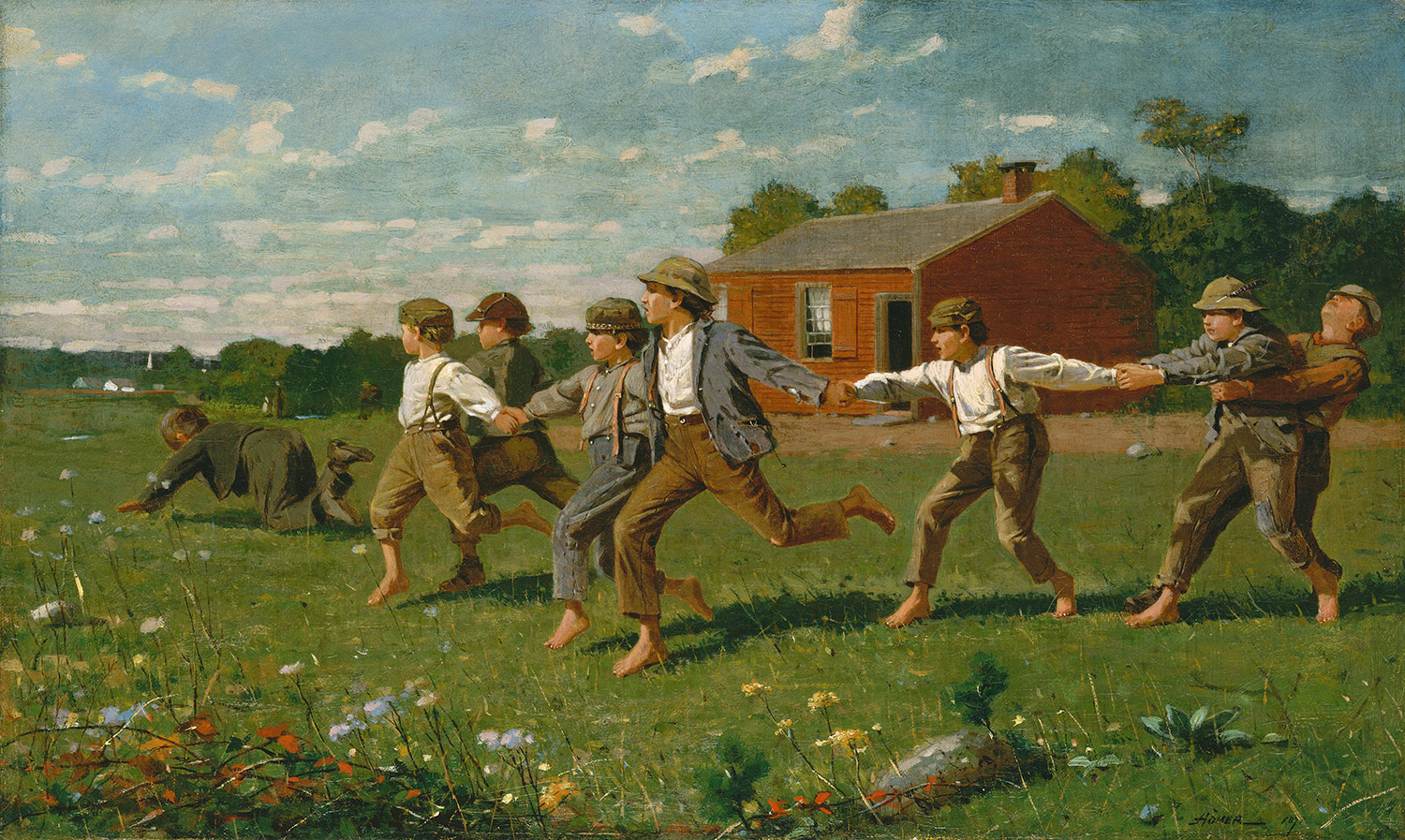
Homer Winslow, Snap the Whip, 1872.


Helen Levitt Photograph,

Friday, October 17, 2014

VTS: Week 8 Blog Assignment

VTS-to Date:

I have become much more comfortable facilitating VTS discussions with my students since my first one.  I no longer feel self-conscious, and I remember the three questions easily.  Since my first VTS experience with my professional peers, I have gained confidence and am able to focus on paraphrasing rather than asking the questions.  Since my first Video assessment, I have thought more intently about the vocabulary I use when paraphrasing because I don’t want to miss the opportunity to scaffold with my students.  Previously, I focused on paraphrasing accurately, but now I am able to give thought to word choice.  This is an area in which I hope to continue to grow.

The most surprising issue I have encountered in my VTS experience is that only male students are participating in the discussions.  My Advisory class consists of 19 students; 11 boys and 8 girls.  In considering possible reasons for the gender divide, I have noted the following:

  • The images we've used thus far only have males in them.
  • The girls in my Advisory are more likely to work on homework before socializing, and they may have chosen this on the VTS discussion days.
  • Some girls belong to clubs or groups that may have met during this time.
  • The boys in this group are more social, especially towards the end of the day.  

I want to work on linking student responses and scaffolding vocabulary through paraphrasing.  My goal is for this to become “automatic” as I facilitate.

Tuesday, October 7, 2014

VTS: Week 7 Blog Assignment

Why not tell?

As I read parts 1 and 2 of “VTS & Information: A Commentary”, I couldn't help but think about my idea of what it means to teach another person.  Education is often thought of as the transfer of information from one person to another, in this case teacher to students.  Unfortunately, we've trained ourselves and our students to expect this exchange.  I've really struggled with this lately in my teaching of seventh graders, because I believe there has to be a shift where students (and teachers) understand teaching differently.  I do not have all the answers, I never will, and I think that’s okay.  I don’t need to be all-knowing, but I do need to be all-guiding, all-inspiring, and all-facilitating.  This, I can do.

The VTS approach to learning, I believe, shares my vision.  In regards to not telling, I noted the line “we stick to what viewers find in an image and let them compute meaning based on what they recognize, not what we teachers know.”  Yes!  This resonates with me because it focuses on the student’s ability to make meaning.  Without this skill of recognizing what is familiar and what is not familiar, then making meaning for ourselves, we are not able to adequately solve problems.

I would defend my position about not telling to a parent, other educator, or administrator  with the explanation from the article that VTS “…is about activating the minds of viewers; showing them how to approach unfamiliar work in the first place-by looking and thinking-and how they can find answers to questions that come up for them.”  Not telling is different from not finding or not knowing.  VTS uses inquiry and observation to help students discover meanings, and it does encourage knowing through collaboration.  When a teacher provides an answer, learning has not occurred.  When a student discovers an answer or finds meaning, learning has occurred at a greater level.

VTS: Week 7 Peer Coaching #2

Peer Coaching #2

Kaj,

I feel for you-having to VTS with different groups, but I think this challenge will help you be a VTS master by the end of the semester! :)  Don't be hard on yourself... what works with one group may not work with another.  Also, I noticed you said these students had experience with VTS, and I wonder if their talkative behaviors are the result of different teacher expectations.  I also wonder if the repetitious observations and personal narratives students gave were the result of their familiarity with the topic of the image.  Even for me, it's hard to look at an image from a different lens when I have been inundated with several similar images.

Your intentional paraphrasing with appropriate language was excellent!  This was a great teaching opportunity without having to point out a "wrong answer" or misuse of the word.  I can see how VTS works to build language skills in a non-threatening environment through your example.  Kudos!

In your reflection, you said you noticed that you forgot the first question... :). This questions may have helped redirect, but I think the second question works best for me because of the word "more".  This may not have the same effect on younger viewers...I'm not sure.  Thank you for sharing Lori's suggestion, as it is a good one that I may try also.  I tend to hold my arm in front of the image too, but didn't think of it until I read your post.

I think you are doing really well with VTS.  Try not to compare one group to the next when thinking about your progress, just focus on your behaviors.  All groups are different and present different challenges, and in your case, you are the only common denominator.  You're definitely reflecting an planning well, which can only lead to continued growth.

Great work, Kaj!
Ginia

VTS: Week 6 Blog Assignment


0388-Freed

Assessing, Reflecting, Planning- Video A (Lesson #1, Image #2)


Assessing Student Engagement & Learning:  Students were excited about the opportunity to VTS again and were engaged during this session.  I noticed their comments went a bit further than last time.  One student respectfully disagreed with another student's inference, which I thought was great because this did not happen at all during the first session.  They began developing a more detailed narrative this time; they moved quickly from simple observations to interpretations/inferences w/ evidence, and revisions of thought.  I think students were challenged this time to explain their thinking with specific language and to make inferences.  I noticed that they made several inferences as to why the boys in the image were doing what they were doing, which indicated their use background knowledge and connecting with personal experiences.

Reflecting on Practice:  I was a little self-conscious at the beginning of the session because I was being filmed, but I expected this.  Once we began, I did feel comfortable and easily remembered the three questions.  I noticed, both during the VTS and when I watched the film, that I said, "What do you see that makes you think that?"  Remembering how important each word of the questions is, I cringed because I realized I was questioning the student's thinking/ideas rather than his observations. I'll be very cognizant of this in the future.  Paraphrasing was easier, but as an ELA teacher, I caught myself focusing more on the vocabulary I was using as opposed to focusing on their observations.  My final thought- in facilitating and watching the video, I noted that my body language felt stiff, and my facial expressions were very flat.  This was the result of my effort to be neutral, but I want to work on neutrality with my normal energy.  I think my students will be more comfortable with me being me also.

Planning:  I want to work on facilitating more naturally. As I gain confidence in asking the questions and paraphrasing, I want to approach VTS the same way I approach other lessons-with energy and enthusiasm.  Understanding that my enthusiasm has to be consistent throughout, I want to at least give it a try.  VTS is fun for students and for me, so I don't want to exhibit the opposite behaviors.

Friday, September 26, 2014

VTS: Week 5 Blog Assignment

I believe VTS will help a student, whom I’ll refer to as Sam, by engaging him in classroom discussions.  Sam is very withdrawn, misses school frequently, and physically shuts down when he feels overwhelmed or pressured.  I have established a positive rapport with Sam because he is in my Language Arts class and in my Advisory, but I feel like this rapport is dependent on my flexibility and lowering or removing the expectation for Sam to work independently.

During the first VTS session, Sam was engaged and seemed interested, but he did not participate in the group discussion.  After I concluded the session, he came to the front of the room and shared his observations and inferences with me privately.  I don’t think this is simply a case of shyness, because he was very comfortable presenting a project (that I helped him complete) in front of the class.  I believe Sam lacks confidence in his ability to learn, to the extent that he will literally retreat under a desk and refuse to move when he feels threatened in the learning environment.

I think VTS can help Sam by creating a sense of classroom community in a non-threatening way for him.  He almost participated in our first VTS by sharing his ideas with me, so I hope he will feel encouraged by the validation he received when he did share with me.  Instead of directing him back to his seat because we were finished, I listened to his observations, paraphrased, and responded neutrally, just as I did with others in the class discussion.  My intention was for him to feel as though he participated, in the hopes that he will share with the group next time.

My plan for our second lesson is to prepare Sam by letting him know earlier in the day that we will be doing another VTS in Advisory.  I want to encourage him by acknowledging his contributions to the last VTS (without mentioning that he only contributed privately, of course) and show my enthusiasm for the activity.  VTS offers an “even playing field” for students by removing the fear of giving a wrong answer or competition among peers, which is what I hope will help build Sam’s confidence.

VTS: Week 5 Peer Coaching #1

VTS Peer Coaching #1

Lori-

The inferences your students made about the image like, “digging for…oil, gold, clay, etc.” and the setting being Egypt “because the colors look like a desert” show background knowledge possibly learned in other content areas.  I think it’s great that they are making inferences and connections!

In response to them being surprised by your paraphrasing, I agree with you- I also think VTS will provide validation for students.  You made me think twice about how I respond to students’ answers in other activities/situations, and I admittedly move on when I receive a correct response.  Using paraphrasing in VTS should help teachers with this as well.  This will make me more cognizant of validating them through acknowledgement with other lessons.

You said students were “relatively engaged” but you did have them view silently before beginning.  Good job!  I had to reiterate the silent viewing with my seventh grade students also.  With more VTS experiences, I think our students will begin to do this without having to be prompted.  This is probably another learned behavior…the teacher puts something on the board, and they immediately start to talk about/question the activity.

I was really impressed with your response to the student who made the comment about the writing.  Whether his intention was to share his observation or to be inappropriate (I’m thinking this may have been an attempt to get a laugh from the others), but you handled it beautifully!

You mentioned the students talking over each other in your reflection and planning- I like the idea of silent hand signals.  An object, like talking stick, came to mind for me- something the student’s have to pass around to signal their turn.  This might not be allowed (for lack of a better word) in VTS; we could ask Mary for some insight.  It also may just take practice.  It sounds like your first lesson went very well!  Great job!

:) Ginia

Saturday, September 20, 2014

VTS: Week 4 Blog Assignment


0248-Serebryakova

Assessing Student Engagement and Learning:

I prepared my Advisory students for the lesson by telling them I had an activity I wanted them to help me with for my Graduate work.  In my Language Arts classes, I have implemented “Connections to Art” with the novel we are reading, The Giver, so they knew the activity would have something to do with art.  As I loaded the image on the SmartBoard, students immediately began to center themselves to view the image.  At first, they began talking about it, so I asked them to view it silently for a few moments.  With a couple redirects, they did as I asked.  Before I could get the first question out, hands immediately went in the air.  Every student was looking at the image, and several wanted to comment immediately.  Students began with direct observations like, “I see boys concentrating on stacking cards.” When I asked “What do you see that makes you say that?” the response described their intent expressions.  I then asked, “What do you see that makes you say those are cards?”  The student responding looked at me sideways with an expression that read, “Come on, Ms. Gowin, are you kidding me?”  :) Moving forward, I knew my second question would be appropriate for them to explain less obvious interpretations.

As students responded (the same few at first, then others joined), the discussion gained momentum. Their observations became more interpretive with evidence.  For example, one student said, “The boys are brothers because they all have the same color hair and their cheeks are reddish.  You know what I mean, how some people’s cheeks always look red? That’s how they are.”  Then another student connected that response with, “They are brothers because they look different ages. If they were friends they would look the same age.”  Up to this point, only male students had volunteered to share in the discussion.  One female student raised her hand and said, “I think the youngest one is a girl because she looks like a girl with short hair to me.”  The others looked for a minute, and then nodded in agreement.

I noticed, during the discussion, that the students seemed to be making meaning as a group rather than individually.  When one student would correct himself, the others would nod in agreement.  I also noticed the students raising their hands right away at the beginning of the discussion, but as it continued they would listen to the person speaking, then wait for me to say, “What more can we find” before raising their hands.  This, for me, was evidence that they were listening to each other to make meaning.   All students were engaged in viewing, but they did not participate in the discussion.  What was interesting to me is that only one girl participated, with one observation about the smallest child in the picture being a girl, and to clarify when a student asked, “What’s in the cup? Are those flowers?” she said, “Yes, they’re forget-me-nots. I know that because I know what forget-me-nots look like and they’re blue.”  Did the girls feel less connected to the image because the group consensus was that the image was of boys playing?  Also, one student with an IEP only contributed once, but he and another student (this is the student with emotional/behavioral difficulties) came up to the front right after I wrapped up the discussion, and wanted to share their thinking only with me. They pointed at the image and began their own VTS.  Why did they not contribute during the group discussion?

Reflecting on Practice:  

I found it difficult to be the facilitator and not a participant.  In thinking about this, I realize it’s because, as a teacher, I am trained to “model, model, model.”  Especially at the onset of the discussion, I felt like my students expected me to lead them.  When someone would ask a yes or no question, like “Is that a doll?” I caught myself blurting out the answer.  I did begin asking the second question more specifically…”What do you see that makes you say they are brothers?” and students would answer with specific evidence.  It surprised me that I felt more pressure to help them think deeply and make meaning (although they were doing this) and I wanted them to enjoy VTS.  Fortunately, when I wrapped up, even though it was the end of the day and time to go home, they wanted to do another and asked if we could do this every day.  That alone, with seventh grade students, is a success!

Planning:

In the future, I am going to focus on stepping aside and being the facilitator rather than a participant. I had to force myself to do this, but I want it to come naturally.  I was so focused on the three questions, which I didn’t struggle with at all.  I’m much more comfortable in front of my students than I was when I did this with my VTS classmates and my professional peers, but in a way that made it more difficult for me to stand back and just facilitate.  I think this will come with intention and practice.

Saturday, September 13, 2014

VTS: Week 3 Blog Assignment

Pre-VTS Assessments:

I want to preface this post by saying that I am grateful to and proud of the students who volunteered to complete this pre-VTS assessment for me.  They worked hard, took the activity seriously, and did not even ask the infamous question, "Is this for a grade?"  :)

What I noticed:  The responses given by my students in the pre-VTS assessments were very similar. Word counts were 59,64,68, and 83, but I noticed the student who wrote the most lengthy observation repeated his initial thoughts.  I found it interesting that each student made a total of 6 observations, which were almost all simple observation/assertions, with a couple detailed observations and interpretations/inferences w/out evidence.  One students did provide evidence for one of his/her interpretations/inferences. The following are examples from each student:

  • "I see two men fishing in the ocean."
  • "Two men have a bunch of fish caught on a net."
  • "The water looks dirty. There's a barrel floating in the water."
  • "You can tell it is a sunrise from the color of the sky."


Kinds of Thinking:  In considering the kinds of thinking discussed by Yenawine, my students are using simple identification.  Using the literacy development analogy, my students are in the "reading readiness" stage because they use concrete language without creating a narrative for the image. Although some of their descriptions were detailed, I did not see evidence of meaning-making in their observations.

Reflecting upon Housin's descriptions of Stage 1 & Stage 2:  I'm not sure my students' responses would be considered Stage 1: Accountive by the description in the reading because their observations did not include personal associations, but they certainly were not making judgments as described in Stage 2: Constructive.  I would classify the responses as observations (Stage 0?).

In doing my professional peer rehearsal, I felt the question, "What do you see that makes you say that?" was unnecessary.  But now, in reading my students' pre-VTS responses, I notice that is the one question of the three they consistently did not answer.  


What surprised me:  As a language teacher, I was pleased by the complete sentences and specific word choice students used to describe the image.  When responding to written narratives, their responses are not as detailed.  I know they are developmentally capable of responding at a more advanced stage, and I suspect they may have been thinking more deeply about the image, but they don't have experience responding to imagery in the written form, hence the literal responses.  I am interested to see if there is a significant difference in the verbal responses students will provide during the first VTS discussion.

Saturday, September 6, 2014

VTS: Week 2 Blog Assignment

Professional Peer Feedback:

This week, during our team planning time, I conducted my peer practice VTS with the teachers on my 7th grade team.  I chose Winslow Homer's "Dad's Coming!" because I felt a little familiar with the artist since I incorporated some of his work in my Tom Sawyer unit lessons.  I have to admit, I felt  more awkward than when I practiced in class because this was my first group who were not at all familiar with VTS.  It was a little slow getting started, so I did begin by sharing my first idea as a viewer.  This did initiated the conversation, and it steadily grew from there.

My peers gave the following feedback:

  • At first they did feel like this did not pertain to them, but gradually began to enjoy the activity and their overall impression was positive.
  • VTS did encourage them to look at the image differently, more intently.
  • They gradually formed a narrative about the image.
  • They noted that my paraphrasing was a good way to model paraphrasing for students and build vocabulary.
  • VTS helped build a community, rather than competition because they were building on what was previously said. 
  • Other's comments guided their observations and helped them "see more".  
  • One of the four teachers has experience viewing art, but was not familiar with this image or artist.  He said VTS made him look at the image and think about it more than he would have on his own.


Monday, August 25, 2014

VTS: Week 1 Blog Assignment

Class Introduction:

I'm Ginia Gowin, and I teach 7th grade Language Arts at Chester Boren Middle School in Centralia, Missouri.  For the purposes of this Visual Thinking Strategies course, I've decided to focus on my Advisory students.  At my school, Advisory is used as a study hall and organization time at the end of the day.  However, each year it proves difficult to motivate students and keep them focused; therefore, the time is often wasted.  I have twenty students in my Advisory class this year, which is actually my smallest class, but also one of my most diverse in regards to students needs.  This class includes some very successful students, students identified as at risk academically, students with special needs, and even one student who, in the past, has exhibited defiance/withdrawal behaviors such as curling up in a ball under a desk and refusing to come out. My hope is to build classroom community for all learners while motivating and engaging students through VTS...and it would be great if none of us retreat to the underside of our desks!